Mali’s military has finally acknowledged a new tactic employed by jihadist fighters in the country’s decade-long unrest.
On September 10, soldiers were deployed for the first time to escort fuel tankers, trucks, and buses from the border with Senegal to Bamako. The route had traditionally been considered safe and had never required protection.
This followed reports of buses being torched by insurgents, signalling a shift in their modus operandi. Fighters linked to al-Qaeda and the Islamic State, active in Mali since 2012, are now setting up blockades along major supply routes from Senegal and Mauritania.
In early September, a video of a burning bus circulated online after two jihadists intercepted it on the Kayes-Bamako road. Reports said the passengers were spared to convey the message.
For jihadists, the tactic underlines the junta’s struggle to regain control.
“The new method of communication by jihadists is meant to create the perception of a blockade in Kayes and Nioro,” Colonel-Major Souleymane Dembele, the army’s spokesperson, told reporters on September 8. While acknowledging “enemy movements,” he insisted they usually last only 20 to 30 minutes.
“Therefore, we cannot talk about a blockade,” he stressed.
Two days later, armed escorts were ordered for vehicles in affected regions. “We are determined to protect our fellow citizens and safeguard our territory,” said Lieutenant Mamadou Coulibaly, head of the first mission.
But attacks have intensified. Images of burning tankers and armed roadblocks are circulating online. Reports say at least 10 buses and dozens of tankers have been destroyed in recent weeks.
On September 12, jihadists claimed to have destroyed 40 tankers along the Kayes-Bamako route, though the military said it repelled the assault. One transport company has suspended services, leaving long queues at bus stations. AFP reported that it even considered sending emissaries to negotiate safe passage.
Even the military admits that jihadist attacks have intensified, with “increased use of drones and a proliferation of improvised explosive devices (IEDs),” army spokesman Dembele said on September 8. He accused the fighters of targeting strategic infrastructure, carrying out direct attacks on civilians, and staging kidnappings.
Analysts warn that targeting supply lines could trigger food shortages, fuel scarcity, and rising discontent against the government. Mali has been under military rule since 2020, when Colonel Assimi Goita seized power. He severed ties with Western allies and turned to Russia for support, bringing in the Wagner Group, now rebranded as Africa Corps.
But Wagner’s operations have fuelled controversy. A recent report by The Sentry, titled 'Mercenary Meltdown: The Wagner Group’s Failure in Mali', described their presence as a “multilayered catastrophe” marked by heavy-handed tactics, operational failures, and worsening insecurity.
The report states that Wagner’s chaos has allowed jihadist groups to expand and deepen recruitment. “If anything, the Malian example illustrates failure on both (military and economic) fronts,” said Justyna Gudzowska, The Sentry’s Executive Director.
The insurgency, which was previously limited to the northern regions and the Mopti area, has now spread south to include areas around the capital, Bamako.
Recent military airstrikes have targeted Kayes, Segou, Nioro, and Kidal, though rights groups say many victims are civilians.
Meanwhile, political instability persists. Coup attempts continue, with the latest in August involving dozens of soldiers, including two generals and a French national.
The government claimed the French national was "acting on behalf of the French intelligence service, which mobilised political leaders, civil society actors and military personnel".
One of the suspects, General Abass Dembele, the former governor of Central Mopti, was dismissed for demanding investigations into alleged extrajudicial killings.
General Goita, the junta leader, was in July granted a renewable five-year presidential term, despite earlier pledges to restore civilian rule by March 2024. Political parties have since been dissolved.
Mali, along with Burkina Faso and Niger, has also withdrawn from the West African bloc Ecowas to form the Alliance of Sahel States.
Africa News of Thursday, 18 September 2025
Source: theeastafrican.co.ke
Insurgents shift tactics as Mali junta struggles for control
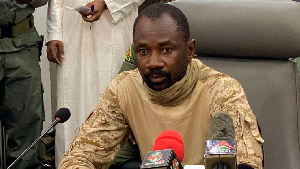 Mali transitional-government leader Colonel Assimi Goita speaking to the press