The mother of Sophia Koetsier, the Dutch medical student who disappeared in Murchison Falls National Park in 2015, broke down in court as she gave harrowing testimony about her daughter’s last known days and the painful aftermath of her disappearance.
Ms Marije Slijkerman, 68, a retired Dutch journalist and film producer from Amsterdam, told the Buganda Road Court yesterday that Sophia, then 21, was her only daughter, a bright medical graduate who had come to Uganda for a two-month internship at Lubaga Hospital through AIESEC before she vanished during a post-internship safari. “She was loving, very beautiful, and intelligent,” said Ms Slijkerman amid tears.
“I feel amputated without Sophia. We have not celebrated her birthday for nine years,” Ms Slijkerman testified before the Buganda Road Chief Magistrate, Ronald Kayizzi.
With trembling hands in a teary voice, Slijkerman reached into her bag and pulled out a collection of photographs of her daughter Sophia, taken both in the Netherlands and during her time in Uganda. Holding them up one by one before the court, she pointed out the dates and locations stamped on the back.
“This one was from her phone… this one was taken in Uganda, at the hospital where she interned.” The courtroom fell silent as Ms Slijkerman’s voice broke. “She was so full of life,” she said.
“These are all I have left. I printed them from my laptop in Amsterdam. I just want people to remember her,” she added.
According to her testimony, Sophia had completed her internship and was on a 17-day tour around Uganda with two Dutch companions and a Ugandan tour operator, Michael Kijjambu of Remikable Adventures, when she went missing on October 28, 2015, at Paraa in Murchison Falls National Park.
Ms Slijkerman said she was in Uganda at the time of the trip, having visited her daughter earlier that month. Sophia had emailed her an itinerary in September 2015, which named Remikable Adventures and Kijjambu as the organiser. “She always kept in touch with me, even sending weekly updates with the family. I knew about the trip; she sent me the plan. I still have that itinerary,” she testified.
Dark turn
But the journey took a dark turn. In Kidepo Valley National Park, Sophia began exhibiting unpredictable behaviour. Ms Slijkerman said her daughter had previously been diagnosed with bipolar disorder at age 16, a condition that caused periodic manic episodes when triggered by stress or exhaustion.
“She would become very active, not sleeping, and seek strangers’ company. She felt good, like she was on top of the world, but it exhausted her,” said Ms Slijkerman.
Ms Slijkerman learnt from Sophia’s companions that her behaviour became erratic during the safari. An English family camping nearby later contacted Slijkerman two years later via email, recalling how Sophia had approached them at 3 am, apologising for disturbing them.
“They said she looked vulnerable and unaware of the dangers around her,” she said. Despite warnings from both the English tourists and park officials to halt the trip and seek medical help, Kijjambu and the group proceeded to Murchison Falls. “Mr Kijjambu was told to stop and take her to a hospital, but he did not. He continued to Murchison Falls National Game Park,” Slijkerman said, visibly shaken. “Why did he ignore all those warnings?” On the evening of October 28, Slijkerman received two phone calls from one of Sophia’s companions.
The first, around 6:30 pm, expressed concern about Sophia’s state and suggested returning to Kampala. The second just before 9:15pm reported that Sophia was missing and was last seen near the student centre at Paraa. “I rushed there, but it was too late,” Slijkerman said. “On October 30, I arrived at the site. I saw some of her things, torn fabric and shoes we had bought together in a store before she travelled to Uganda.” Sophia was never found.
Confrontation
Kijjambu and the other two travellers left the park on November 2. Ms Slijkerman said she confronted him before he left and also received an invoice for the trip, which was used to support an insurance claim. Sophia paid €1,600 for her share of the tour, totalling €4,800 for the group. “She told me it covered everything except food and drinks,” said Ms Slijkerman. The court heard that Sophia had disclosed her mental health condition to her companions five days into the trip. However, Kijjambu allegedly described her as “crazy” and failed to act on advice to seek medical care.
“I never told him directly about her condition because she was an adult,” Ms Slijkerman explained during cross-examination. “It was her right to disclose it.” She also revealed that she had no contact with Kijjambu during the trip from Kidepo to Murchison Falls and was not informed of any problems. “He took them to an unsecured student centre. It’s not well manned. That’s where she vanished,” she said. “He knew she was unwell and ignored all warnings,” she added. Now nearly 10 years , Sophia remains missing.
Ms Slijkerman said the disappearance shattered her family. “I cannot concentrate. None of us sleep well. It changed our lives completely.” The defence, led by lawyer Ponny Mugwanya, objected to the admission of several documents, including the trip itinerary and invoice, arguing they were not properly authenticated. But the prosecution, led by Ms Joan Keko, insisted they were traceable to Slijkerman’s emails and laptop in Amsterdam. The case, in which Kijjambu is accused of operating as an unlicensed tour operator, resumes August 5.
Background
Sophia Koetsier was a 21-year-old medical student from the Netherlands, remembered by her family as bright, compassionate, and full of promise. She travelled to Uganda in 2015 through the global youth exchange platform AIESEC for a two-month internship at Lubaga Hospital in Kampala.
Passionate about global health, Sophia had plans to return to the Netherlands to begin her career in medicine. She was also open about her struggles with bipolar disorder, which she had managed since age 16.
According to her mother, Sophia loved travel and cultural exchange, which led her to embark on a 17-day safari around Uganda after completing her internship. Her disappearance on October 28, 2015, during that tour, remains a mystery nearly a decade later.
Africa News of Wednesday, 9 July 2025
Source: monitor.co.ug
How Dutch student vanished in Ugandan park 10 years ago
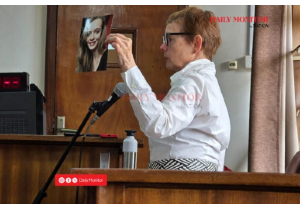 Ms Marije Slijkerman displays her daughter’s picture at the Buganda Road Chief Magistrate’s Court



Entertainment