The Ministry of Health has confirmed an imported case of Ebola Bundibugyo virus disease in Uganda.
The Ministry's Permanent Secretary, Dr Diana Atwine, said, in a statement released on Friday, that the case involves a 59-year-old Congolese man who had been admitted to Kibuli Muslim Hospital in Kampala on May 11, 2026.
He is said to have presented with respiratory distress, fever, epigastric pain, nausea, and difficulty passing urine.
"While in admission, he deteriorated and died on May 14, 2026, in the Intensive Care Unit with bleeding symptoms," Dr Atwine said. The body was taken back to the Democratic Republic of Congo at 8 pm the same day.
On May 15, the ministry received reports of a suspected Ebola case from public health authorities in DRC and tested a sample collected from the deceased during care.
"The sample was taken for testing at the Central Emergency Surveillance and Response Support laboratory in Wandegeya, where it was confirmed as Ebola Bundibugyo. This is an imported case from DRC. The country has not yet confirmed a local case," Atwine said.
The ministry has activated its response. Teams have been deployed for screening, surveillance, and rapid response at official and informal border points, especially along the western border, major transit routes, and pilgrimage corridors.
The ministry has activated its response. Teams have been deployed for screening, surveillance, and rapid response at official and informal border points, especially along the western border, major transit routes, and pilgrimage corridors.
Response structures have also been activated at the national level and in high-risk districts, including deployment of a mobile laboratory at Bwera Hospital, isolation arrangements, infection prevention and control, and risk communication.
"One high-risk contact who is a close relative to the deceased has been isolated. We are currently quarantining all contacts who came into contact with the index case," Atwine said.
She urged health workers to maintain a high index of suspicion and follow safety precautions.
"The Ministry of Health urges all health workers to have the highest index of suspicion and maintain heightened safety precautions. Private clinics are encouraged to observe the Standard Operating Procedures and report any suspected case to the nearest district health authorities," she said.
She urged health workers to maintain a high index of suspicion and follow safety precautions.
"The Ministry of Health urges all health workers to have the highest index of suspicion and maintain heightened safety precautions. Private clinics are encouraged to observe the Standard Operating Procedures and report any suspected case to the nearest district health authorities," she said.
The public has been advised to avoid physical contact with anyone showing symptoms, wash hands frequently, and avoid contact with bodily fluids such as urine, blood, sweat, saliva, vomit, and stool.
"Handling of dead bodies suspected to have Ebola-like symptoms should be supervised by the health team and undergo a safe and dignified burial to prevent further spread within the communities," Atwine said. All public places have been urged to provide handwashing facilities.
For suspected cases, the public should call the Ministry of Health toll-free line 0800-100-066 or send a free SMS to 6767.
About Ebola
Ebola is a viral, acute disease that can be fatal if untreated. It spreads through close contact with blood, secretions, organs, or bodily fluids of infected animals or humans, and through objects contaminated with those fluids. Early symptoms include sudden fever, fatigue, chest pain, diarrhoea, vomiting, and yellowing of the eyes, with bleeding often appearing later.
Africa News of Saturday, 16 May 2026
Source: monitor.co.ug
Uganda confirms Ebola case after Congolese man dies in Kampala
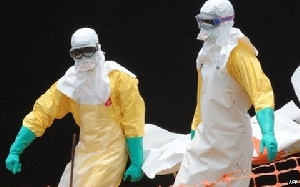 A file photo of some health professionals