Officials in the Democratic Republic of Congo are calling for the urgent establishment of safe humanitarian corridors to help combat the spread of Ebola.
The outbreak of the rare Bundibugyo strain of the deadly virus in the east of the country has failed to halt fierce fighting between the army and armed groups in the region.
Its proliferation is unfolding in provinces already dealing with fragile health systems, food insecurity, and mass displacement as a result of the ongoing conflict.
The disease has spread to both South Kivu and North Kivu, which are on the frontline of fighting, pitting the army against the AFC/M23 coalition.
Congo’s Minister of Public Health, Samuel Roger Kamba Mulamba, said it was not the first time officials called for a humanitarian corridor.
"We had asked that the response, whether for Mpox or now, not be a sequenced one, meaning there should not be one response for the country and then a micro-response for Goma, because that will not be effective,” he said.
Mulamba said that officials were having difficulties convincing people to keep their distance from those suspected of having the virus.
He reiterated that it was transmitted through contact and that it was “dangerous to touch the patient, dangerous to touch a corpse because it is contagious”.
The World Health Organization says at least 220 people are now believed to have died from the haemorrhagic fever.
Suspected cases in the DRC have surpassed 900, while health authorities in Uganda reported two new Ebola cases on Monday, bringing the number of infections there to seven.
All the cases are linked to the Congo outbreak, which appears to have started several days or weeks before authorities in that country declared it on 15 May.
Africa News of Wednesday, 27 May 2026
Source: africanews.com
DR Congo officials call for safe humanitarian corridors amid Ebola outbreak
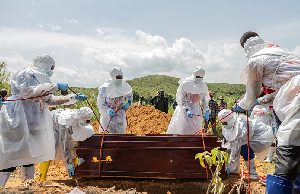 Red Cross workers bury an Ebola victim in Rwampara, DR Congo, 23 May 2026