President Bola Tinubu has formally accepted Professor Mahmood Yakubu’s departure as Chairman of the Independent National Electoral Commission following the expiration of his second and final tenure.
Following the development, the president is set to name Yakubu’s successor after the Council of State meeting in Abuja on Thursday, after presenting the list of nominees for the coveted number one electoral umpire position.
Yakubu Tuesday handed over to May Agbamuche-Mbu, a seasoned legal expert, who has assumed the role of acting chairman pending the appointment of a substantive successor.
In recognition of his service, the president conferred upon the ex-INEC boss the national honour of Commander of the Order of the Niger.
Former Presidents Olusegun Obasanjo and Goodluck Jonathan, state governors, and other members of the Council of State are expected to advise Tinubu on the next INEC chair.
The Special Adviser to the President on Information and Strategy, Bayo Onanuga, in a statement on Tuesday, disclosed that Tinubu thanked the outgoing INEC boss for his services to the nation.
The statement titled ‘President Tinubu Accepts INEC Chairman’s Departure, Bestows National Honour on Him,’ read, “President Tinubu thanked Professor Yakubu for his services to the nation and his efforts to sustain Nigeria’s democracy, particularly through the organisation of free and fair elections throughout his two-term tenure.
“In recognition of Yakubu’s dedicated service to the nation, President Tinubu has bestowed on him the honour of Commander of the Order of the Niger.
“President Tinubu also directed that Professor Yakubu should hand over to the most senior national commissioner, May Agbamuche-Mbu, who will direct the affairs of the commission until the completion of the process to appoint a successor.”
In a letter dated October 3, 2025, Yakubu expressed gratitude to the president for the privilege of overseeing the commission for two terms.
Tinubu, in turn, thanked him for sustaining Nigeria’s democracy and conducting elections he described as “free and fair” across his tenure.
Yakubu was first appointed in November 2015 as INEC’s 14th chairman for a five-year term.
Following Senate confirmation, he was reappointed in 2020 for another five years, which has now concluded.
Over the decade, Yakubu oversaw the 2019 and 2023 general elections and numerous off-cycle polls.
Under his leadership, INEC introduced the Bimodal Voter Accreditation System for voter verification and the Results Viewing Portal to allow instant public access to polling unit results.
In November 2021, INEC piloted BVAS during the Anambra governorship election, which was the first time it was deployed in a state-wide election.
It was used in the FCT Area Council elections and some off-cycle governorship polls (Ekiti and Osun) in 2022.
It was fully implemented nationwide during the 2023 general elections, mandated by the Electoral Act 2022.
Yakubu institutionalised a system of continuous registration and updates of voter records, breaking away from only registering citizens ahead of elections.
During his tenure, the number of polling units increased significantly, bringing election access closer to many communities across Nigeria.
The erstwhile INEC boss also championed a consistent election timetable while increasing collaboration with political parties, civil society organisations, international observers, and media to ensure better oversight and trust in the process.
Yakubu established the Election Monitoring and Support Centre and other predictive systems to track performance across polling units using performance indicators.
Under him, INEC introduced provisions to support persons with disabilities, priority voting for the elderly and vulnerable groups, and measures to ensure internally displaced persons could better participate.
Despite political pressure and intense public scrutiny, Yakubu managed to preserve INEC’s institutional independence. He continuously emphasised neutrality and adherence to constitutional guidelines.
However, Yakubu’s tenure was not without controversy as the 2023 election recorded technical glitches and delays blamed on system failures and transmission lags.
Political actors often accused INEC of favouring one side, especially during tight contests. During elections, polling units experienced late arrivals of materials or security lapses, particularly in volatile areas.
Furthermore, voter apathy and scepticism about election fairness remained concerns throughout his tenure.
Speaking on the agitation for new selection guidelines for the appointment of a new INEC chairman, a Senior Advocate of Nigeria, Ifedayo Adedipe, dismissed the growing debate over who should appoint the INEC chair, describing it as a distraction from Nigeria’s deeper governance and electoral issues.
Speaking on the controversy surrounding the appointment process, Adedipe questioned the fixation on the matter, recalling that former President Goodluck Jonathan appointed Prof Attahiru Jega, who went on to conduct the election Jonathan lost in 2015.
“Was it not Jonathan who appointed Professor Jega? Didn’t Jonathan lose the election? We should focus on other things rather than this issue of who appoints whom or what,” he said.
Adedipe argued that the challenges undermining Nigeria’s elections were not tied to who headed INEC but to the conduct and mindset of political actors and citizens.
“Does the chairman of INEC come to polling units? No. On election day, politicians give money to voters — they call it ‘see and buy.’ Those are the things you should think of how you are going to address, not who appoints whom,” he stated.
According to him, the integrity of elections depends on the character and conduct of citizens and officials, not on who occupies the INEC chairmanship.
“The next chairman does not mean we are going to have a good election. It is who we are,” Adedipe added.
Adedayo Adedeji, SAN, maintained that nothing was wrong with the President appointing Yakubu’s successor.
He stated, ‘’Yes, he has the power to appoint, subject to confirmation of the Nigerian Senate. Sections 153 and 154 of the Constitution are instructive on this. I am of the view that there is nothing inherently wrong with the President appointing the chairman.
‘’We have established checks and balances through the Senate confirmation process, which allows the people’s voice to be heard. Any appointee must undergo a thorough screening process, free from political bias.’’ Adedeji, however, called for extensive consultation before any appointment to ensure a well-rounded decision.
‘’There was a time when a Committee on the Reform of INEC made a recommendation at a point in time. It was to the effect that the President should not be allowed to continue to appoint the INEC chairman, but unfortunately, that reform did not see the light of day.
So, the question has come to the fore, in view of the fact that I heard today that the Chairman of INEC has submitted his retirement notice, and the most senior national commissioner has been appointed to be in charge, in the name of Mrs. Agbamuche. So, I am strongly of the view, you see, there’s an attempt by the current president to bring in transparency and independence into the appointment of an INEC chairman.
‘’So, as it is now, the President will appoint, but the President will present such nominees to the Council of State. You know, the Council of State is made up of the Governor, the Vice President, the former President, the former Chief Justice of Nigeria, and all of them. Where it is, as it is now, it is simply for advisory purposes.
‘’It’s not as if they can actually reject it. So, people are now calling for more reform to be brought into the appointment process, such as the fact that some people have even suggested that the Supreme Court should be the one to appoint. However, my candid view is on the quality and the calibre of the person that is appointed.’’
Wale Balogun, SAN, proposed a credible selection process, noting that the checks and balances in the system are sufficient to produce a reliable INEC umpire.
He added, ‘’So, I am of the strong view that we just need to firm up the process in such a way that a credible person can be appointed and we have such a system that can independently vet such persons.
The reform, the checks and balances that the system has, as it is today, is sufficient to produce a credible person, but then, the system as it is now is also weak, so weak that it may not be able to actually checkmate the President if the President appoints a person who is not credible to that office. This is the concern that I have.’’
The senior lawyer observed that a rigorous screening process ought to guarantee a credible electoral system.
Africa News of Wednesday, 8 October 2025
Source: punchng.com
Countdown to 2027: Tinubu to pick new INEC chair this week
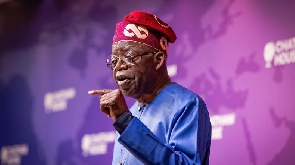 Bola Tinubu is the president of Nigeria




Entertainment