The United States is banking on the Washington Peace Accords, designed to end conflict in the Democratic Republic of Congo (DRC), to underpin a new Africa policy that shifts away from aid dependency towards business-driven engagement.
President Donald Trump, who declared on Thursday that “everybody will make money” in peaceful Congo, followed up with the release of a new US National Security Strategy. The document seeks to minimise aid, elevate commerce in relations with Africa, and tighten immigration rules.
Published just hours after Rwandan President Paul Kagame and Congolese leader Félix Tshisekedi signed the peace deal, the strategy acknowledges flaws in past approaches.
“For far too long, American policy in Africa has focused on providing, and later on spreading, liberal ideology,” it states. “The United States should instead partner with select countries to reduce conflict, foster mutually beneficial trade, and transition from a foreign aid paradigm to an investment and growth paradigm capable of harnessing Africa’s abundant natural resources and latent economic potential.”
Although Africa is not a primary focus of US foreign policy —Washington prioritises the Western Hemisphere and Indo-Pacific — the Strategy highlights opportunities through conflict resolution, reform of aid and investment frameworks such as the Africa Growth and Opportunity Act, and countering Islamist militancy, all while avoiding long-term military commitments.
The DRC-Rwanda accord, alongside efforts in Sudan, Ethiopia-Eritrea, and Nile Basin disputes, is presented as evidence of Trump’s “deal-making” diplomacy. The strategy lists the Congo peace deal as one of his administration’s achievements.
“President Trump has cemented his legacy as The President of Peace… leveraging his deal-making ability to secure unprecedented peace in eight conflicts worldwide over just eight months of his second term,” it says.
The cited agreements include Cambodia-Thailand, Kosovo-Serbia, Pakistan-India, Israel-Iran, Egypt-Ethiopia, Armenia-Azerbaijan, and Gaza.
Critics remain cautious, noting that implementation of the Congo deal could face obstacles. Yet the Washington Accords for Peace and Prosperity are framed as a compendium of peace and commercial agreements, placing security and trade side by side.
Among them is the Economic Integration Framework between the DRC and Rwanda, billed as a “bold roadmap for peace, security, and unprecedented economic growth.” The US also signed a Strategic Partnership Agreement with the DRC, a memorandum on expanded security cooperation, and a US-Rwanda Framework for Shared Economic Prosperity.
A bilateral health cooperation deal with Kenya was also concluded.
Washington insists these agreements reflect a broader shift: reducing
reliance on aid and political pressure in favour of business.
“The United States should transition from an aid-focused relationship with Africa to a trade- and investment-focused relationship, favouring partnerships with capable, reliable states committed to opening their markets to US goods and services,” the Strategy explains.
Energy and critical minerals are identified as immediate investment priorities. US-backed nuclear, petroleum, gas, and liquefied natural gas projects are expected to generate profits while securing access to strategic resources.
The pivot is partly driven by rivalry with China. The US-China Economic Review Commission warned in its 2025 report that Beijing’s expanding commercial and technological influence in Africa must be curbed, or Washington risks future dependence. China’s trade with Africa, at $250 billion this year, is nearly four times that of the US.
China’s approach — focused on infrastructure, trade, and minerals, with little emphasis on governance — appears to be shaping Washington’s recalibration. The US now says it will cut out NGOs, having already dismantled USAID.
In September, China’s Civil Engineering Construction Corporation signed a $1.4 billion deal with Tanzania and Zambia to revive the Tazara railway, linking copper mines to Dar es Salaam port. Meanwhile, the US and EU launched the Lobito Corridor project with Angola, the DRC, and Zambia to connect copper-rich regions to Angola’s Atlantic
port.
On Friday, Washington and Brussels reaffirmed support for the Corridor.
“The Government of the United States and the European Commission stand ready to discuss financing proposals to ensure synchronicity with rehabilitation on the Angolan side, maximising efficiency and success,” they said. “We remain fully aligned and coordinated to support the Corridor’s success, securing transparent supply chains and sustained investment.”
The Strategy stresses that the US will no longer be omnipresent in Africa but will defend its global influence by protecting core interests through soft power, military strength, technology, and commerce.
“The United States cannot allow any nation to become so dominant that it could threaten our interests,” it warns. “We will work with allies and partners to maintain global and regional balances of power to prevent the emergence of dominant adversaries. As the United States rejects the ill-fated concept of
global domination for itself, we must prevent the global, and in some
cases, even regional, domination of others.”
Africa News of Sunday, 7 December 2025
Source: theeastafrican.co.ke
Congo peace deal plays into Trump’s push for business in Africa
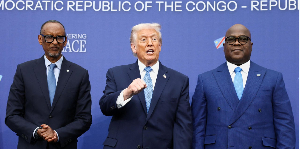 Prez of Rwanda Paul Kagame (L) Donald Trump (C) and DRC Prez Felix Tshisekedi