The aftermath of Tanzania’s post-election violence has forced government officials into a firefight they never planned for, dealing a blow to a foreign policy that had sought a smooth path forward.
In May, Tanzania relaunched a foreign policy document promising to uphold sovereignty, territorial integrity, and political independence, while protecting freedoms, justice, human rights, equality, and democracy, and promoting good neighbourliness and African unity.
The policy aims to deepen economic cooperation with development partners; support non-alignment and South-South cooperation; collaborate with the UN on international development, peace, and security; and safeguard Tanzanian social values.
President Samia Suluhu Hassan outlined a “dual-track” strategy: prioritising relations with neighbouring countries, East African Community (EAC) partners and Africa, while separately managing ties beyond the continent.
She argued this would revitalise cross-border trade under EAC harmonised protocols, attract multinational companies, and place economic diplomacy and regional integration ahead of all else. This approach shifts Tanzania from its historic role as a peaceful but somewhat isolated nation to a more economically engaged regional actor.
“This is a journey of new thinking in building our diplomatic presence and positioning our country and government on the international stage,” President Suluhu said on 19 May.
At the time, Tanzania was resolving trade disputes with Kenya, addressing 20 non-tariff barriers after years of conflict. “Trade wars have led to monopolies and protectionism, eroding global commerce and shaking the foundations of our promised globalisation,” she said.
The new policy also commits to strengthening regional infrastructure, including highways with Kenya, the metre-gauge railway to Zambia, and the Standard Gauge Railway to Burundi and the Congo, enhancing trade and security cooperation.
However, Tanzania did not plan to engage in shuttle diplomacy to defend its political developments or address allegations of police brutality and election irregularities.
In the immediate aftermath of the post-election chaos, officials initially denied police abuses and defended the results. President Samia later accused protesters of plotting a regime change with unnamed foreign backers and, even after apologising for the deaths, blamed parents for failing to guide their children.
This stance drew criticism from the UN Human Rights Office, Amnesty International, and a warning from the US that it was reviewing relations.
Dodoma appears to have learned from its missteps, favouring diplomatic engagement over outright denial, while balancing defence of its sovereignty with responses to human rights allegations.
The focus on political damage control has distracted from Tanzania’s core foreign policy pillar: economic diplomacy. This explains the recent push to engage the US, aiming to safeguard $43 billion in pending investment deals.
Africa News of Sunday, 21 December 2025
Source: theeastafrican.co.ke
Post-poll chaos leaves dent in Tanzania's foreign policy
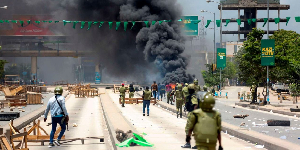 Tanzanian riot police disperse demonstrators during violent protests that marred the election