Carlos Queiroz’s rebuilding of the Black Stars is not simply about replacing old players with younger ones.
The Portuguese coach is attempting to reshape both the personnel and the way Ghana play, following years of inconsistency and Ghana’s failure to qualify for the 2025 Africa Cup of Nations.
A blend of experience and youth
One of the clearest features of Queiroz’s approach has been his willingness to combine established internationals with players making their way into the senior team.
At the 2026 World Cup, players such as Benjamin Asare, Jerome Opoku, Kojo Oppong Peprah, Kwasi Sibo, Caleb Yirenkyi, Augustine Boakye, Christopher Bonsu Baah, Brandon Thomas-Asante and Prince Kwabena Adu were handed their World Cup debuts.
How Carlos Queiroz’s Black Stars era compares with previous generations
That process has continued into the new AFCON qualifying cycle. For the September qualifiers, Queiroz retained much of the World Cup core while bringing in players such as Ronald Donkor and Jan Gyamerah and recalling Ibrahim Osman and Nathaniel Adjei.
The idea is clear: maintain enough experience to compete while gradually creating the next Black Stars core.
A different kind of Ghana team
The more noticeable change, however, has been tactical. The Black Stars under Queiroz have become considerably more comfortable without the ball.
Rather than automatically trying to dominate possession, Ghana have often dropped into a compact defensive structure, allowed opponents to have the ball and looked for opportunities to attack quickly when possession is regained.
The clearest example came against England at the 2026 World Cup.
Ghana defended in a compact 4-5-1, deliberately reduced the spaces between the lines and allowed England to control possession.
That is a significant departure from some of Ghana’s previous generations.
The 2006–2010 teams and much of the 2011–2017 era had midfielders capable of taking responsibility for possession and driving the team forward. The modern Black Stars are increasingly being built around structure, transitions and efficiency rather than possession for possession's sake.
Queiroz has defended this approach as modern, strategic football rather than simply defensive football. His argument is that Ghana should defend when necessary and attack when opportunities appear.
He is also looking beyond the usual pool
Another part of the rebuild has been Queiroz’s attempt to understand Ghana’s domestic talent pool.
The coach revealed that he established a local observation programme to assess home-based players and accelerate his understanding of Ghanaian football.
He has also emphasised areas beyond tactics, including nutrition, fitness, physiotherapy, tactical preparation and set pieces.
That matters because rebuilding a national team is not the same as rebuilding a club.
Queiroz has limited time with his players and therefore needs a larger pool from which to select, while establishing standards that can be implemented quickly during short international windows.
What is working?
The defensive organisation is perhaps the clearest positive so far.
Ghana showed against England that they could frustrate a major opponent without needing to dominate possession.
The Black Stars collected four points from their first two World Cup group matches and eventually reached the knockout stage for the first time since 2010.
There has also been a willingness to trust younger players rather than simply relying on the established names.
That could become important as the older core gradually moves out of the national-team picture.
But there are still questions
The biggest question is whether Ghana can turn this defensive solidity into consistent attacking production.
Being organised without the ball is one thing; consistently creating and finishing chances against teams that sit deeper is another.
The Côte d’Ivoire defeat exposed that problem. Ghana were able to compete without dominating possession, but ultimately left Bouaké with a 2-0 defeat.
There is also a broader question about identity.
Previous Black Stars generations often tried to impose themselves on opponents. Queiroz’s team is more willing to concede territory and possession and wait for the right moment.
That can make Ghana harder to play against, but it also places greater demands on the team's ability to transition quickly, create chances with fewer possessions and take those chances when they arrive.
The rebuild is still unfinished
Queiroz therefore has two jobs. He must create a new generation of dependable international players, while simultaneously deciding how aggressive or pragmatic the next Black Stars should be.
The early signs suggest he has chosen structure and defensive organisation as the foundation.
The next stage is to make that foundation produce more goals, more control and, ultimately, more consistent results.
FKA/EB
2027 AFCONQ: Black Stars Hold First Training Session Ahead of Côte d’Ivoire Clash
Sports News of Monday, 28 September 2026
Source: www.ghanaweb.com
Inside Carlos Queiroz’s Black Stars Rebuild: The changes, football and big questions
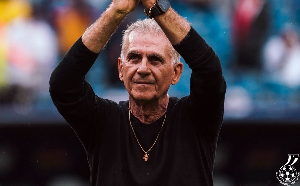 Carlos Queiroz is the head coach of the Black Stars