For months, Ghanaian football fans have been divided over one of the Black Stars' most debated positions: the goalkeeper.
On one side is Lawrence Ati Zigi, the experienced and trusted pair of hands whose shot-stopping ability has earned him the confidence of successive national team coaches.
On the other hand is Benjamin Asare, the newer face whose composure on the ball and ability to build attacks from the back have convinced many supporters.
The debate took on another dimension at the 2026 FIFA World Cup. Ati Zigi started Ghana's opening Group L match against Panama before an injury forced him off at half-time.
World Cup 2026: Ghana's Benjamin Asare ranked 6th best goalkeeper
Asare stepped in and performed well enough to keep his place for the remaining group-stage matches against England and Croatia.
Once Ati Zigi recovered, however, he was restored to the starting line-up for Ghana's Round of 32 clash against Colombia.
Both goalkeepers had opportunities to influence Ghana's campaign, but who actually performed better?
Using data from FIFA's Training Centre, I break down their performances across every major aspect of goalkeeping.
Shot-stopping: Advantage Ati Zigi
If goalkeeping is ultimately judged by preventing goals, Lawrence Ati Zigi enjoyed the stronger tournament.
Although Benjamin Asare faced more shots overall, with 35 attempts recorded across his appearances against Panama, England and Croatia, Ati Zigi produced the higher number of decisive goalkeeping actions. The experienced goalkeeper registered seven goal interventions compared to Asare's five.
His standout performance came in the Round of 32 against Colombia, where he was called into action repeatedly as Ghana came under relentless pressure.
The statistics show Ati Zigi making six save-and-deflect interventions and another save that he retained, underlining just how often he was forced to protect Ghana's goal.
Workload: Different challenges, same volume
The workload numbers reveal two different stories. Benjamin Asare faced the greater overall volume of shots during Ghana's tournament.
After replacing Ati Zigi against Panama, he was tested heavily across the group stage, facing eight shots in the second half against Panama, 19 against England and another eight against Croatia, a total of 35 attempts.
Ati Zigi, meanwhile, faced 23 shots across his two appearances, with three coming against Panama before injury and 20 arriving in the knockout meeting with Colombia.
The Colombia knockout match heavily influenced those figures, forcing Ati Zigi into one of Ghana's busiest individual goalkeeping performances of the tournament.
Distribution: Asare embraced the modern role
Where Ati Zigi excelled in traditional goalkeeping, Benjamin Asare distinguished himself in possession.
Modern football increasingly demands goalkeepers who can initiate attacks, and FIFA's Enhanced Football Intelligence metrics place significant emphasis on a goalkeeper's ability to break opposition lines with accurate distribution.
Throughout the tournament, Asare consistently looked to play progressive passes rather than simply recycle possession.
Breaking the lines
The line-break statistics further highlight Asare's influence with the ball.
He completed almost twice as many successful line-breaking passes as Ati Zigi during the tournament, showing a clear willingness to bypass opposition midfield and defensive units with ambitious distribution.
Against England, despite facing one of the tournament's strongest pressing teams, Asare attempted 17 line-breaking passes and completed eight.
Building from the back
Perhaps the clearest difference between the pair comes through FIFA's "offers to receive" metric.
This measures how often a goalkeeper actively moves into space to provide a passing option for teammates.
Benjamin Asare made ten offers to receive during the tournament. Lawrence Ati Zigi made just two.
Possession involvement
Asare's influence extended beyond passing.
He finished the tournament with more possession regains than Ati Zigi.
His increasing involvement was also evident in his overall match activity, recording 36 involvements after replacing Ati Zigi against Panama before increasing to 47 against England and 50 against Croatia.
Passing efficiency
While Asare attempted the more ambitious passes, Ati Zigi proved to be the more efficient distributor.
He completed 75 per cent of his passes compared to Asare's 69 per cent.
The coaches' decision
The tournament itself tells an interesting story.
Asare replaced an injured Ati Zigi against Panama and did enough to retain the starting position throughout the remainder of the group stage.
That decision was undoubtedly justified by his performances.
Yet once Ati Zigi regained full fitness, the coaching staff immediately reinstated him for the knockout stages.
His display against Colombia went a long way towards explaining why.
So, who came out on top?
The FIFA Training Centre data does not produce a definitive winner because the two goalkeepers excelled in different areas.
Ati Zigi was the stronger shot-stopper. He produced more decisive interventions, handled sustained attacking pressure more effectively and delivered Ghana's standout goalkeeping performance against Colombia.
Asare, meanwhile, was the more progressive goalkeeper. He contributed significantly more to Ghana's build-up, completed more line-breaking passes, offered himself as a passing option far more frequently and became an important part of the team's attacking structure.
In many ways, the statistics reflect the modern debate surrounding goalkeeping itself.
If the priority is preventing goals under sustained pressure, the numbers lean towards Lawrence Ati Zigi.
If the priority is helping a team dominate possession and progress attacks from the back, Benjamin Asare makes an equally compelling case.
FKA/JE
GhanaWeb launches maiden Real Estate Platform
Sports News of Monday, 13 July 2026
Source: www.ghanaweb.com
Ati Zigi vs Benjamin Asare: Who came out on top at the 2026 World Cup?
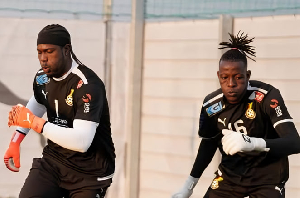 Lawrence Ati Zigi (L) and Benjamin Asare are goalkeepers of the Black Stars