For many African football fans of a certain generation, the name “Zaïre” evokes a vivid blend of images: Mobutu Sese Seko Kuku Ngbendu Wa Za Banga, perhaps the politician with the longest name on the continent, in his leopard-skin hat; the rhythmic energy of Kanda Bongo Man and Engelbert, the football club later known as TP Mazembe, whose continental dominance once shaped African football history.
DR Congo, vast and turbulent, often felt like a giant haunted by its own history. Africa’s second-largest country and the 11th largest nation in the world has long embodied a paradox of immense natural wealth alongside political fragility and economic hardship. Belgian colonial rule left deep scars: an extractive economy, pseudo-scientific racial hierarchies and a violent governance model that independence struggled to repair.
The assassination of Patrice Lumumba, followed by years of internal conflict, set the stage for Mobutu’s authoritarian state, a regime wrapped in spectacle and symbolism but unable to escape deeper structural weaknesses.
Yet even during its most difficult eras, Congo projected a cultural and sporting influence that travelled far beyond its borders.
Global Spotlight in Kinshasa
Long before South Africa hosted the 2010 World Cup, Kinshasa had become a global stage. In 1974, the “Rumble in the Jungle” brought Muhammad Ali and George Foreman to the Stade du 20 Mai. The event was more than a boxing spectacle; it was a major public relations coup for Mobutu’s government; a declaration that Africa could host, inspire and command worldwide attention.
For readers of a younger generation, just two months earlier in August 1974, Ghana had made its own historic shift, switching from driving on the left to the right in the famous “Nifa Nifa"
That same year, Zaïre’s national football team achieved a remarkable milestone. With only one African slot available at the 1974 World Cup, Zaïre qualified as continental champions; the first sub-Saharan African nation to compete on football’s grandest stage.
Their campaign at the 1974 FIFA World Cup in West Germany was unforgiving: a 9–0 defeat to Yugoslavia remains one of the tournament’s harshest scorelines, while a 3–0 loss to Brazil entered football folklore.
During a Brazil free kick, Mwepu Ilunga suddenly ran out of the defensive wall and blasted the ball away before the kick could bebtaken.
Many assumed he did not know the rules, but later accounts suggested it was likely a deliberate act, either protest or disruption, turning the moment into one of the World Cup’s most talked-about incidents to date.
Despite the results, Zaïre’s qualification signalled a new African ambition. It also exposed the gulf that existed at the time between Africa’s finest and the world’s strongest sides. Half a century later, that gap has narrowed dramatically: Cameroon reached the quarter-finals in 1990, followed by Senegal in 2002 and Ghana in 2010 before Morocco went one step further by reaching the semi-finals at the 2022 World Cup in Qatar.
A Global Footprint
Today, Congolese influence is visible across world football. European clubs are enriched by players of Congolese descent, including Romelu Lukaku, Steve Mandanda, Christopher Nkunku and current national team members, captain Chancel Mbemba, Aaron Wan-Bissaka, Yannick Bolasie and Gaël Kakuta as well as Vincent Kompany, now head coach at Bayern München.
Their careers reflect a diaspora whose identity and success remain linked to the country of their parents and grandparents.
Meanwhile, TP Mazembe carved its own continental legacy, winning multiple CAF Champions League titles and engaging in fierce rivalries, particularly with Ghana’s Asante Kotoko, a rivalry still remembered with nostalgia across Africa.
The Leopards’ Resurgence
In recent months, DR Congo’s national team, currently ranked 48th in the world under French Head Coach Sébastien Desabre, has written a new chapter in this long, complex story.
In a series of crucial fixtures in Rabat, Morocco, the Leopards overcame Cameroon’s Indomitable Lions by 1-0 with a late goal from Captain Mbemba and then, defeated Nigeria’s Super Eagles in a tense continental play-off final that ended 1-1 before winning 4-3 on penalties , two African heavyweights whose status usually intimidates even the strongest sides.
For many Congolese at home and in the diaspora, the victories sparked rare moments of uncomplicated national pride. In the dressing room after the match against Nigeria, a video circulated widely on social media: players dancing, singing and embracing a future they could finally believe in. Led by Augsburg striker Samuel Essende, the squad chanted playfully that they had beaten "Africa's Giant Goliath" and we will soon defeat Ghana too.
Their confidence was infectious. Even after extra time and a penalty shoot-out, they looked ready for another 90minutes.
Beyond the Pitch
Congo’s football revival is unfolding against the backdrop of a difficult national reality. In the east, several armed groups continue to battle for territory, often clashing with one another and with government forces.
As of late 2025, according to the UN's International Organization for Migration (IOM), over 7.7 million people are currently displaced internally due to the conflict, making this one of the world's largest displacement crises.
For millions, daily life is shaped by insecurity and displacement but sports offers a rare moment of collective pause, a shared window of hope. At the height of Manny Pacquiao’s boxing fame, local lore suggested that crime took a pause whenever he stepped into the ring, though statisticians note this remains anecdotal.
In its own way, Congo’s dream mirrors that sentiment: that political and military leaders might find space for calm, even if briefly, so that attention turns to the players who represent the nation each time they step onto the pitch.
As DR Congo prepare for their decisive final play-off later this month in Mexico, the Leopards stand one match away from returning to football’s biggest stage. Having been seeded due to their improved FIFA ranking, they will face the winner of the Jamaica/New Caledonia semi-final in the Inter-confederation Play-off Final.
For a nation of more than 112 million people, qualification would offer more than just sporting achievement; it would symbolise resilience through decades of turbulence and a chance to project a different national story to the world.
From the global spotlight Ali brought to Kinshasa during the Rumble in the Jungle, to Mazembe’s continental triumphs, from Mobutu’s symbolism to the Leopards’ renewed confidence, Congo’s story : sporting and otherwise is one of endurance. A country repeatedly pushed to the edge yet consistently capable of producing moments that captivate Africa and the world.
Sports News of Sunday, 15 March 2026
Source: Frank Akwasi Afriyie, Contributor
From Zaïre to Today: How DR Congo’s Leopards are roaring again
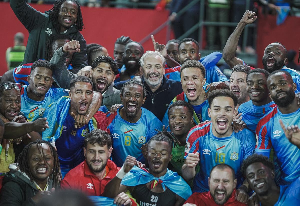 DR Congo are a game away from making it to the 2026 World Cup