At the 2002 World Cup, Ronaldo arrived looking for redemption. While sporting one of the most unique haircuts in football history, the Brazil striker found exactly what he was searching for.
This is ICONS - a GOAL podcast and feature series that revisits the last 10 World Cups from unique perspectives, bringing the spirit of the tournament back to life.
Do you know what a ‘skin’ is? Literally, it means ‘skin’, but in the modern slang of gaming and social media, it refers to the outfit, costume, or accessories that define one of the visual identities of an important character.
Great heroes have multiple skins - each one representing a different chapter of their story. For Ronaldo, ‘Il Fenomeno’, his most legendary skin is the one that gave him a hideous, almost comical tuft of hair - but nevertheless brought happiness to millions of Brazilians all over the planet.
Ronaldo, the first of his name among football’s immortals, lived through some of the sport’s most iconic moments and was top scorer everywhere he went. At Cruzeiro and PSV, early in his career, he still wore an ordinary haircut to go with his boyish, innocent smile. At Barcelona, he popularised the shaved-head look like no one else, all while shocking the world with explosive runs, dazzling dribbles and clinical finishes that made him a player far ahead of his time.
His ‘Inter skin’ represented the peak of his physical powers until it was shattered by a devastating knee injury that many believed would end his career. The Ronaldo with the ‘Cascao haircut’, on the other hand, became the image of his redemption - a hero’s apotheosis in yellow and green; a symbol of one of football’s greatest heroes’ journeys; a look that not only defined his image forever but also an entire World Cup. And to think it all started as a joke during a moment of tension.
Injuries, drama and determination
Brazilians have a peculiar way of finding humour even amid hardship. Despite endless social challenges, they’re still known as people who laugh. Yet the smiles after Brazil’s 2–1 comeback win over England in the 2002 World Cup quarter-finals didn’t last long.
Ronaldinho, the genius behind the improbable winning goal, would miss the semi-final due to a red card. But the real bad news concerned the other Ronaldo - the one and only Ronaldo of that era.
Brazil’s No.9 began feeling pain in his thigh during the first half against England and was substituted with 20 minutes to go. Even amid the post-game celebrations, he already knew the situation was serious.
"I want to see you get me ready for the next match. I want to see if you’re good," he told the team doctor, Jose Luiz Runco, in footage later shown in Ronaldo's documentary on Globoplay. It wasn’t a light-hearted challenge, more a plea from a man who’d been through hell before.
From the infamous seizure hours before the 1998 World Cup final to that demand in 2002, life had tested Ronaldo like few others. The toughest trial came in April 2000, during Inter’s Coppa Italia clash with Lazio, when he suffered a devastating injury to his right knee, tearing his tendon in his very first match back after five months of recovery. The image of Ronaldo crying on the turf became one of football’s most heartbreaking scenes.
The timeline of his injuries was alarming. In late 1998, inflammation in both knees sidelined Ronaldo for months. He returned in January 1999, but pain persisted, and in April, he was ruled out for another eight weeks. A minor thigh strain followed in May, and then, in November of that year, came the partial rupture of his right knee tendon. When he finally returned in April 2000, it was only to suffer the complete rupture moments later.
By the time Luiz Felipe Scolari announced Brazil’s final squad for the 2002 World Cup, Ronaldo had played only 19 matches since that night in Rome, completing the full 90 minutes in just three of them. After nearly two years without football, he was to be thrown straight into the most intense competition on Earth. Only during that World Cup, against Costa Rica and Belgium, did he finally manage to play back-to-back full games again.
‘If you’ve got half a leg, you play!’
Though he tried to appear calm following the England game, Ronaldo wasn’t much of an actor. Reports from the time noted his unusual silence and serious expression, while both Scolari and Runco shared that same unease. There was good news when early scans revealed no muscle tear, and the absence of knee-related headlines brought a dose of optimism. Still, the tournament’s top scorer - tied with Rivaldo and Miroslav Klose on five goals - was in pain.
"Medicine isn’t an exact science. Each case is unique," Runco told O Globo amid that wave of anxiety. "I believe he’ll play, but I can’t guarantee it."
While his team-mates trained on the pitch, Ronaldo spent his days in physiotherapy, electrotherapy and cryotherapy as he did everything he could do to play.
His injury record was terrifying. Even his call-up had been a gamble, especially as Romario had been left out to national outcry. In the months leading up to the World Cup, Ronaldo had suffered five muscle injuries - all in his right thigh, and none had healed as quickly as the five days separating the win over England and the semi-final against Turkey.
"His injury worries us," Scolari admitted, "but I trust our medical team - and, more importantly, the player’s willpower. I don’t believe he’ll miss the semi-final. We need everyone now. If you’ve got half a leg, you play! Ronaldo knows Brazil needs him. He’s been a technical and emotional leader for this team."
Birth of the Cascao
Seeing Ronaldo smile again was the first good sign. During an interview with Japan’s Nippon TV on the eve of the semi-final, he declared he’d be ready to face Turkey: "I was more tired than the others, but in two or three days I’ll be fine. After all, I’ve played so many games in a short period. After two years without football, it’s been intense."
Runco’s tone was also lighter, but no one was truly relaxed. Imagine Ronaldo’s situation: years of meticulous preparation, only to be derailed by injury every time. Maybe, in a butterfly-effect kind of way, that’s why he decided to change his ritual.
"I always shaved my head before matches," Ronaldo recalled in his documentary. "This time, I left a patch. I walked down the hotel corridor… Everyone laughed, made jokes, teased me, saying I didn’t have the guts to show up for training like that."
Scolari, on the other hand, was furious. "'What’s that haircut?!' I was nervous, upset. 'Why do this now? What if it backfires? Did you ask my permission?’ I was p*ssed off!” he explained, years later, in the same film.
But the manager had other things to worry about. Ronaldo barely moved during the final training session, and everyone who saw it reported it. Could he really play? Doubt on one side, conviction on the other: Ronaldo was keeping the haircut.
"I can’t disappoint all the little kids who copied it," he said with a grin at a press conference.
The haircut was an instant hit. It dominated news cycles worldwide as fans and kids imitated it everywhere, while even Turkish midfielder Umit Davala’s mohawk drew 'hair duel' headlines.
Ronaldo has often talked about that haircut, always downplaying any special or magical plan of his own. But he admitted it served a purpose, as it shifted attention away from his injury.
"I was only at 60 per cent, so I shaved my head. Everybody was only talking about my injury. When I arrived in training with this haircut, everybody stopped talking about the injury," he told The Sun in 2017. Planned or not, that ridiculous tuft of hair brought the levity everyone needed.
Sports News of Thursday, 5 February 2026
Source: goal.com
How Cascao haircut changed everything for Ronaldo and Brazil at the 2002 World Cup
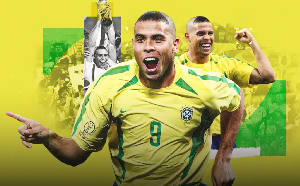 Ronaldo scored twice in the 2002 World Cup final against Germany