To close the gap between education, research and industry in the field of biomedical engineering, a joint project between five private sector German and Ghanaian companies and GIZ is improving training and providing laboratory equipment for biomedical engineering students at the Kwame Nkrumah University of Science and Technology and University of Ghana.
This move will position the biomedical engineering (BME) students to graduate with job-ready skills that are in high demand across hospitals, manufacturing firms, and medical service providers nationwide.
Equipping the two bioinstrumentation laboratories was made possible under the “Upskilling Biomedical Engineers for Ghana” project.
This so called “development partnership with the private sector” is jointly facilitated by medical technology and diagnostic companies B Braun, Delft Imaging, Drager and Sysmex Europe and the adaptive learning platform Area9 Lyceum.
It is implemented by the Deutsche Gesellschaft für Internationale Zusammenarbeit (GIZ) GmbH on behalf of the German Federal Ministry for Economic Cooperation and Development (BMZ) and funded through the develoPPP programme.
The retrofitted laboratories replicate real clinical environments, enabling students to develop practical skills in medical equipment installation, maintenance, diagnostics, therapeutics and innovation with equipment from project partners.
This marks a significant shift from theory-heavy training to practice-oriented learning that aligns with the needs of Ghana’s rapidly evolving healthcare system.
The expected impact extends beyond education. By helping to build a workforce of job-ready graduates, the initiative is expected to improve the availability and use of medical and diagnostic equipment in health facilities, enhance patient care, improve access to diagnostic and therapeutic care and create new employment opportunities in biomedical services, medical device distribution, and local manufacturing.
Beyond new equipment, the project is transforming how biomedical engineering is taught. Courses at both universities are being revamped to place greater emphasis on applied learning, problem-solving, and exposure to industry-standard technologies.
This approach ensures graduates are better prepared for employment while also encouraging local innovation in medical devices and healthcare solutions.
Prof Dr Torsten Wagner, a lead consultant on the project, speaking on behalf of the five private companies said, “For the medical technology companies, access to graduates who already understand their equipment and industry standards is a game-changer. These labs will shorten onboarding time, boost productivity, and support the growth of local medical device services.”
The Project Manager at GIZ Headquarters, Dr Helene Widmer, also noted, “This project aligns with broader development goals; strengthening local capacity, improving healthcare outcomes, and creating sustainable employment opportunities for young Ghanaians.”

The official launch of the laboratories will take place on February 26, 2026, at the UG campus.
The Director for Allied Health at the Ministry of Health, Dr Ignatius A N Awinibuno underscored the importance of investing in biomedical engineering education.
Dr Awinibuno made this statement when he delivered the Keynote Address at the launch of enhanced Bioinstrumentation Laboratories as part of the “Up-skilling Biomedical Engineers for Ghana” initiative.
"These practical Bio-instrumenation Labs will therefore serve as incubators of innovation and for the next cutting-edge health product. They are spaces where students move from passive learning to active creation, where curiosity meets circuitry and diagnostics meet design.
“Ideas will be tested, refined, and transformed into solutions that respond directly to Ghana’s healthcare realities. Therefore, investing in biomedical engineering education is not a peripheral undertaking. It is central to strengthening health systems," he noted.
Health News of Saturday, 28 February 2026
Source: www.ghanaweb.com
Retrofitted biomedical engineering labs to train industry-ready graduates
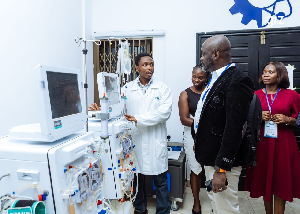 Some of the leaders inspecting one of the labs




Entertainment

Van Vicker 'slaps' LilWin with GH¢10m defamation suit


Opinions