Government moves to establish Ghana Space Agency
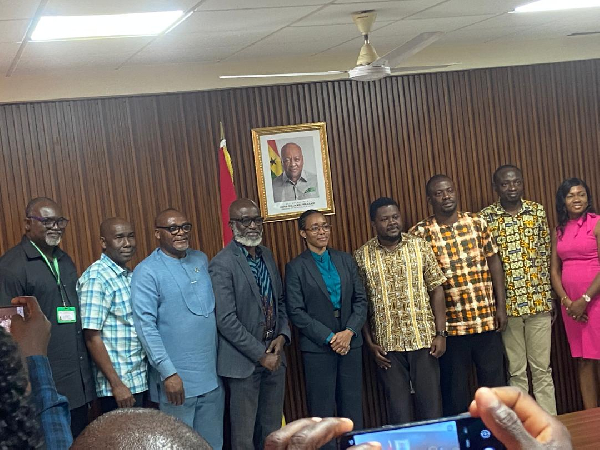
The government has announced plans to transform the Ghana Space Science and Technology Institute (GSSTI) into a fully-fledged Ghana Space Agency as part of a broader strategy to position the country to benefit from the emerging global space economy.
Minister of Environment, Science and Technology, Dr Zanator Agyeman-Rawlings, said the proposed institutional transformation would provide Ghana with the legal, technical and operational framework needed to coordinate the country's space activities and develop national space programmes.
Addressing stakeholders in Accra on Friday, October 2, 2026, Dr Agyeman-Rawlings said processes were underway to draft legislation for the establishment of the agency following Cabinet's approval.
She said the proposed agency would coordinate Ghana's space activities, facilitate research and innovation, promote public-private partnerships and international cooperation, support the development of space infrastructure and strengthen Ghana's participation in the global space economy.
The minister said, “Ghana could no longer regard space science and technology simply as a symbol of technological prestige”, arguing that space-based systems had become essential infrastructure for modern development.
According to her, “satellite technology already supports telecommunications, broadcasting, weather forecasting, navigation, financial transactions, agriculture, environmental monitoring, disaster management, maritime surveillance, national security and scientific research.”
From Banker in London to Leader in Agribusiness: Meet Catherine Krobo Edusei
She said Ghana's focus must therefore be on applying space technology to address concrete national development challenges.
A major component of the government's agenda is the use of satellite imagery, Earth observation, drones, geospatial systems and artificial intelligence to improve environmental management.
Dr Agyeman-Rawlings said space technologies could provide critical information on deforestation, illegal mining, land degradation, water bodies, wetlands, biodiversity, coastal ecosystems, waste management, air quality and climate-related risks.
She said the technology could help the country move from reactive environmental management to evidence-based and predictive governance.
The minister particularly highlighted its potential in the fight against illegal mining and the degradation of water bodies, saying Ghana needed credible, timely and spatially disaggregated information to identify environmental changes, support enforcement and measure the impact of interventions.
She also pointed to the potential of satellite information and artificial intelligence to provide early warnings of flooding, monitor changes in forest cover, improve agricultural decision-making and track coastal erosion and changes in marine ecosystems.
The proposed space agenda will be built around five strategic pillars, beginning with institutional transformation and extending to space infrastructure, environmental sustainability, human capital development and private-sector participation.
Under the infrastructure and data pillar, the government intends to explore partnerships and investments to strengthen Ghana's space-related infrastructure and data systems.
Dr Agyeman-Rawlings said the value of satellite imagery lay not merely in obtaining images but in the country's ability to convert space-based information into actionable intelligence for policy and decision-making.
On human capital, she said Ghana's greatest space asset would not necessarily be a satellite but the Ghanaian who designs, builds and operates it, analyses its data and develops businesses from it.
She called for stronger collaboration among universities, research institutions, industry, government agencies and international partners, while encouraging more young Ghanaians to pursue careers in aerospace engineering, satellite engineering, astrophysics, remote sensing, geospatial science, artificial intelligence, robotics, data science, telecommunications, space law and policy, and space entrepreneurship.
AM
Inside Ghana’s Abandoned Engineering Powerhouse: What Went Wrong?
Source: www.ghanaweb.com« Previous |
Next »