Home - 40% to Private Firm, 60% to Government: Inside Akufo-Addo's 11-year deal Mahama is implementing
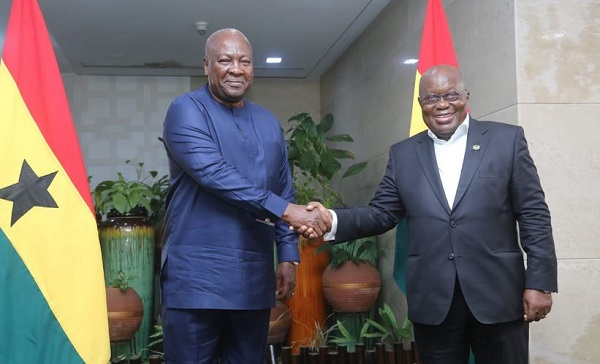 The introduction of Ghana’s automated traffic enforcement system, TraffiTech-GH, has generated considerable public interest, with motorists raising questions about its operation, the penalties for traffic violations and the financial arrangements underpinning the programme.
The system, which uses automated cameras, sensors and other digital technology to detect traffic offences, is intended to strengthen road safety and improve compliance with traffic regulations.
However, beyond its stated road safety objectives, attention has increasingly turned to the private company behind the technology, the ownership structure of the business and how much the government stands to receive from the arrangement.
Although the programme is being implemented under President John Dramani Mahama’s administration, the agreement dates back to December 2022, when the government of former President Nana Addo Dankwa Akufo-Addo signed an 11-year contract with Nationwide Traffic Management and Enforcement Limited (NTMEL). The agreement is expected to run until December 2033.
Information attributed to the Ministry of Finance’s 2024 Public-Private Partnership Report puts the estimated investment in the project at GH¢77.73 million. The arrangement provides for the design, deployment, financing, operation and maintenance of automated traffic enforcement infrastructure, including speed detection cameras, red-light monitoring systems and associated software.
TraffiTech-GH: Concerned Drivers Association accuses MTTD of 'digital extortion'
How the 40-60 revenue arrangement works
One of the most contentious aspects of the agreement is the revenue-sharing arrangement between the government and the private operator.
According to a report by theheraldghana.com, the government is entitled to 60 per cent of the fines collected under the programme, while NTMEL receives the remaining 40 per cent. This means that for every GH¢100 collected from motorists as traffic fines, the government receives GH¢60, while the private company takes GH¢40.
The arrangement has raised questions about the commercial interests attached to a programme whose primary stated objective is to improve road safety. Critics have questioned whether allowing a private company to receive a percentage of traffic fines could create an incentive to maximise citations rather than focus exclusively on changing driving behaviour.
The financial arrangement is, however, distinct from the ownership structure of NTMEL. The Herald reports that Ghanaian businessman Frank Osei owns 60 per cent of the company, while Sensys Gatso International B.V. holds the remaining 40 per cent. Thus, the 60-40 split in the ownership of NTMEL should not be confused with the 60-40 division of traffic fine revenue between the government and the company.
Who owns NTMEL?
NTMEL, which is at the centre of the implementation of TraffiTech-GH, is a joint venture involving Ghanaian businessman Frank Osei and Sensys Gatso International B.V., a company associated with Sweden's Sensys Gatso Group.
According to the ownership details reported by The Herald, Osei holds a controlling 60 per cent stake in NTMEL, making him the majority shareholder. Sensys Gatso International B.V. owns the remaining 40 per cent, giving the Swedish-linked company a substantial interest in the Ghanaian traffic enforcement project.
Sensys Gatso Group is an international traffic safety technology company listed on Nasdaq Stockholm. It specialises in automated traffic enforcement solutions, including speed detection technology, red-light monitoring systems and other equipment used to monitor road users.
The company's involvement in Ghana dates back to the agreement signed in December 2022. In a December 23, 2022, announcement, Sensys Gatso disclosed that it had secured the 11-year contract through its 40 per cent joint venture interest in NTMEL. It said it would provide management and technology throughout the contract period, with NTMEL responsible for operating the national road safety programme.
What Sensys Gatso stands to gain
The commercial value of the agreement was further highlighted in a statement issued by Sensys Gatso Group on September 10, 2026, ahead of the programme's launch.
The company estimated that total contract revenue for NTMEL over the remaining period of the agreement would be approximately 600 million Swedish kronor (SEK). It also confirmed that its 40 per cent shareholding in the joint venture entitles it to 40 per cent of the profits generated by the programme.
The projected SEK600 million represents expected revenue for the joint venture and should not be interpreted as guaranteed profit or as the amount Sensys Gatso will automatically receive. The company's actual returns will depend on NTMEL's financial performance, operating costs and the investments required to sustain the programme.
Sensys Gatso also disclosed that the initial phase would require additional investment in equipment, operational infrastructure and other programme assets. It expects the joint venture to become profitable after this investment and expansion phase.
The group's Chief Executive Officer, Lew Miller, described the Ghanaian programme as an opportunity to expand its international operations while contributing to road safety.
“At Sensys Gatso, we are committed to saving lives by changing driver behavior,” he stated.
He said the initiative would allow the company to deploy its experience and technology to improve road safety in Ghana.
How the Akufo-Addo agreement reached the Mahama administration
Although the agreement was signed under the Akufo-Addo administration in December 2022, its full implementation has taken place under the government of President John Dramani Mahama.
Sensys Gatso's original announcement indicated that the project would involve an initial implementation phase, during which the organisation, back-office systems and external technology interfaces would be established and tested. The first phase of enforcement was expected to involve a limited number of speed guns and fixed and mobile traffic cameras, followed by a gradual expansion of the equipment and operational infrastructure.
The company initially projected that revenue generation would begin in the second half of 2024. It also indicated that the programme would create more than 100 jobs and that NTMEL would operate it until the end of 2033, when the programme is scheduled to be transferred.
The delay between the signing of the agreement and the full rollout meant that the project did not reach its current enforcement stage during the Akufo-Addo administration. The Mahama administration has consequently inherited and proceeded with the existing contractual arrangement rather than negotiating an entirely new 11-year deal.
How TraffiTech-GH works and who enforces it
Under the programme, automated cameras, sensors and other enforcement devices are deployed to detect traffic violations, including speeding and running red lights. The system also uses mobile and in-vehicle cameras, as well as laser speed-measurement devices.
According to the Ghana Police Service, footage and images captured by the equipment are transmitted to a back office for review and validation before an Electronic Notice of Violation (ENV) is issued to the registered owner of the vehicle.
The Police Service, through its Motor Traffic and Transport Department (MTTD), is responsible for reviewing the evidence and issuing the electronic notices. This means that although NTMEL is the private sector partner providing the technology and supporting the programme, the Police retain the enforcement responsibility.
Other public institutions involved in the broader programme include the Ministry of the Interior, Ministry of Finance, National Road Safety Authority (NRSA), Driver and Vehicle Licensing Authority (DVLA), National Insurance Commission and National Identification Authority.
The Ghana Police Service says motorists who receive an electronic notice have 14 days to pay the prescribed fine or challenge the alleged violation. Those who dispute a citation can contest it online and request a hearing. Failure to pay within the stipulated period attracts an additional penalty of one per cent of the original fine for each day of default.
The system eventually went live on November 1, 2026, with the initial enforcement focusing on speeding at selected high-risk locations.
On November 2, 2026, Assistant Commissioner of Police Alexander Kwaku Obeng, the MTTD's Director of Education, Research and Training and project coordinator, disclosed that some motorists had been recorded travelling at speeds exceeding 130 kilometres per hour on roads with a prescribed limit of 50 kilometres per hour.
However, the introduction of the system was quickly followed by another challenge: fraudsters began circulating fake traffic violation messages to motorists.
On November 4, 2026, the Ghana Police Service cautioned the public against fraudulent messages demanding payment for alleged traffic offences through unofficial channels. The Service said genuine electronic notices would come from the official sender identification, GPS-MTTD, and advised motorists to verify the vehicle registration number, photograph, location, date and time of the alleged offence before making payments.
The Police also warned motorists against clicking suspicious links or transferring money to personal mobile money accounts, directing them instead to approved government payment channels.
BAI
SayItLoud: Newly constructed road turns Nsakina into a nightmare whenever it rains
Source: www.ghanaweb.com
News of 2026-11-05
