Home - Today in History: The bombs that almost stopped Queen Elizabeth II’s historic visit to Ghana
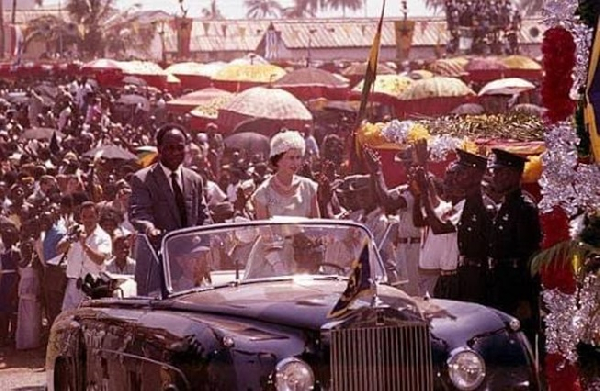 A day before November 5, 1961, two bomb explosions rocked Accra, targeting landmarks associated with President Kwame Nkrumah and Queen Elizabeth II’s impending royal visit.
The attacks raised fears over the Queen’s safety and threatened to overshadow one of the most significant diplomatic moments in Ghana’s early post-independence history.
On November 5, 1961, Ghana was caught in the middle of a political and diplomatic storm following two bomb explosions in Accra that had occurred the previous day, November 4. The attacks came just days before Queen Elizabeth II was scheduled to arrive in the country for her historic 11-day state visit, turning what was expected to be a major celebration of Ghana-Britain relations into a security concern.
The first explosion targeted the bronze statue of Ghana’s first President, Dr Kwame Nkrumah, located outside Parliament House in Accra. The blast reportedly destroyed the feet of the life-sized statue, in what was widely interpreted as an attack against the President and his government.
A second bomb exploded near a storeroom at the base of the Freedom and Justice Arch at Black Star Square, the venue where the Queen was expected to receive a military salute during her visit. The explosion caused damage to the structure and injured a night watchman.
The incidents came at a particularly sensitive time for Ghana. Although the country had gained independence from Britain in 1957 and become a republic in 1960, political tensions under Nkrumah's administration were mounting. His government faced growing opposition, while concerns about political repression and the direction of his leadership continued to attract international attention.
The bombings therefore carried significance beyond the physical damage they caused. With the Queen's visit approaching, the explosions raised serious questions about security arrangements and whether Ghana could safely host the British monarch.
In Britain, the attacks generated considerable anxiety, with members of Parliament and sections of the public questioning whether the royal trip should proceed.
British Prime Minister Harold Macmillan was particularly concerned about the Queen's safety. His government dispatched Commonwealth Relations Secretary Duncan Sandys to Ghana to assess the security situation and determine whether the visit could go ahead.
However, Queen Elizabeth II was reportedly determined not to abandon the trip.
In a response to concerns about the potential danger, she was quoted by TIME magazine as telling Macmillan: "I am not a film star. I am the head of the Commonwealth — and I am paid to face any risks that may be involved."
Her determination was also influenced by the diplomatic importance of the visit. The trip had initially been scheduled for 1959 but was postponed because the Queen was pregnant with Prince Andrew. Cancelling or postponing it again risked sending the wrong message to Ghana, particularly at a time when Nkrumah's relationship with Britain and the wider Commonwealth was becoming increasingly delicate.
There were also broader Cold War considerations. Britain was concerned about Nkrumah's growing relationship with the Soviet Union and the possibility that a cancellation could push Ghana further away from the Commonwealth.
Following security assessments and consultations, the British government gave the visit the green light.
Queen Elizabeth II eventually arrived in Ghana in November 1961, accompanied by her husband, Prince Philip, for the historic 11-day tour from November 9 to 20.
Despite the security concerns preceding her arrival, the Queen received an enthusiastic welcome, with large crowds gathering to catch a glimpse of the royal visitors.
One of the most memorable moments of the trip came during a state dinner in Accra, where Nkrumah and the Queen exchanged remarks that reflected the changing relationship between Ghana and its former colonial ruler.
Nkrumah declared: "The wind of change blowing through Africa has become a hurricane."
He added that whatever political changes might come, the personal regard and affection between him and the Queen would remain.
The Queen, in turn, emphasised that differences among Commonwealth countries did not mean they had to abandon their association.
The visit would also produce one of its most memorable photographs: Queen Elizabeth II dancing with Nkrumah during the state visit, an image that came to symbolise the changing relationship between Britain and independent Ghana.
More than six decades later, the November 1961 bombings remain a striking reminder of the political tensions surrounding Ghana's early years as a republic and the security concerns that accompanied one of the country's most consequential royal visits.
What could have become a diplomatic embarrassment for Ghana instead proceeded as planned, with Queen Elizabeth II refusing to let the threat of violence determine whether she would visit the country.
EA
Source: www.ghanaweb.com
News of 2026-11-05
