Africa News of Friday, 10 October 2025
Source: monitor.co.ug
Uganda: This is not the independence our fathers fought for - diaspora leader

As Uganda marked 63 years of independence, Ugandans living in the diaspora used the occasion to deliver a sobering message about the state of governance, democracy, and public welfare in their homeland.
In a joint statement, they expressed deep concern over what they described as the steady erosion of democratic principles and widening social inequality, developments they say betray the dreams of the nation’s founding fathers.
Leading the call, Dr Dennis Daniel Ssemugenyi, a prominent voice within the Ugandan diaspora community, said the country stands at a critical crossroads, urging citizens to reclaim the true spirit of independence and confront the forces of corruption and oppression.
“We are standing at a crossroads in our nation’s history, and our economy is in crisis. Prices rise day and night while wages remain stagnant. Businesses are closing as corruption flies high. This is not the independence our fathers fought for,” he said.
Dr Ssemugenyi painted a bleak picture of the current state of social services, particularly in the health sector, which he said had been neglected for far too long.
“Our hospitals, once symbols of compassion, are now stories of despair. Mothers give birth on the floor, patients wait endlessly for medicine that never comes, and doctors, once the pride of our nation, have been reduced to beggars in their own country,” he said.
Turning to political governance, Dr Ssemugenyi decried what he termed the slow death of democracy and the shrinking space for independent voices. He cited the recent presidential nomination process as evidence of bias within the electoral system.
“The recent nominations exposed deep cracks in our democracy. Independent candidates who speak for the people were deliberately excluded and silenced,” he said.
He revealed that he filed a petition on September 26 demanding fairness, but to this day, the Electoral Commission remains silent.
“That silence is not ignorance, it is the loudest confession of bias and fear,” he added.
He warned that the erosion of electoral integrity risks plunging the nation into political disillusionment.
“When an electoral body becomes a branch of the ruling regime, elections stop being instruments of democracy and become rituals of deceit. A nation that can no longer trust its ballot stands on the edge of its last resort,” Dr Ssemugenyi noted.
The diaspora leader also criticised Uganda’s justice system, accusing it of shielding the powerful while abandoning the weak.
“Ordinary Ugandans no longer believe that the courts can deliver justice. Case files disappear, judges are intimidated, and the law serves only the powerful. This is not justice, it is legalized oppression,” he said.
Reflecting on the meaning of independence, Dr Ssemugenyi urged Ugandans to use the anniversary not merely as a celebration but as a moment of national reckoning.
“Independence is not real until every Ugandan is free from fear, poverty, and injustice. We must awaken the spirit of our founding fathers, those who dreamed of self-rule, peace, and equality. Let us celebrate the past but reclaim the future,” he said.
He concluded with a rallying call for civic renewal and unity among Ugandans at home and abroad.
“The greed for power has become a cancer eating the soul of Uganda. It has stolen our dreams, divided our people, and turned citizens into subjects,” he said. “But while the regime can hold power, it cannot hold the souls of Ugandans. Our destiny belongs to us, and together we can rebuild our nation.”
Dr Ssemugenyi’s remarks have resonated widely within diaspora communities, many of whom say the fight for a just, accountable, and inclusive Uganda must continue, guided by the same ideals that inspired the country’s struggle for independence in 1962.
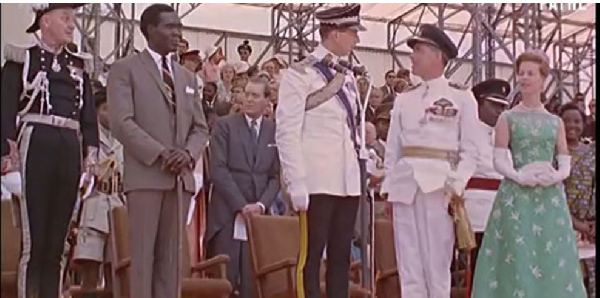
Left to right: Governor Sir Walter Coutts, Prime Minister Apollo Milton Obote, Duke of Kent Edward (C), and Duchess of Kent Katharine (R) during celebrations to mark Uganda’s Independence at Kololo in Kampala on October 9, 1962.



Entertainment